Just the two of you
Two-player game-night ideas for an evening away from another screen
Two chairs are enough. The useful choice is what you want to do together.
Editorial choices, not personalized results or hands-on reviews. We may earn from qualifying purchases through the paid links below.
Two players. Three different rhythms.
For two players, consider original Sushi Go! for competing over card combinations, The Mind for a shared challenge with limited communication, or original Qwirkle for turn-based color-and-shape tile play. All three reviewed ranges include two, but their rhythm and demands are different.
For two people who want a friendly rivalry
Original Sushi Go!
2–5 · ages 8+ · competitive pick-and-pass
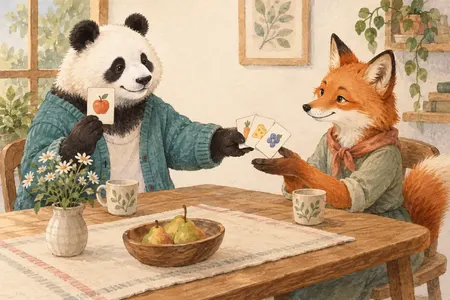
The pick-and-pass format centers choosing combinations and passing the remaining hand. The reviewed original range includes two; read the two-player rules rather than importing another edition's format.
Skip it if: One person dislikes that format or you mainly want a cooperative challenge.
Check before buying: Match Original Sushi Go!, the English-language edition and the actual group count. Gamewright lists ages 8+ and 15 minutes; learning time and your own group's playing time can differ.
For two people curious about a shared silent challenge
The Mind
2–4 · ages 8+ · cooperate without card talk
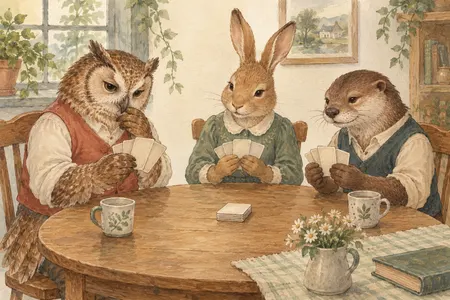
Number cards and constrained communication create a different activity from talking over a conventional card hand. It is a shared game attempt, not actual mind reading.
Skip it if: Keeping up a conversation is the point of the evening or either person dislikes this kind of waiting.
Check before buying: Confirm the original The Mind by Pandasaurus, English instructions and ages 8+. The publisher lists 15 minutes; a first explanation and repeat attempts may take longer.
For two people who would rather think through a turn
Original Qwirkle
2–4 · ages 6+ · 108 wooden tiles · growing layout
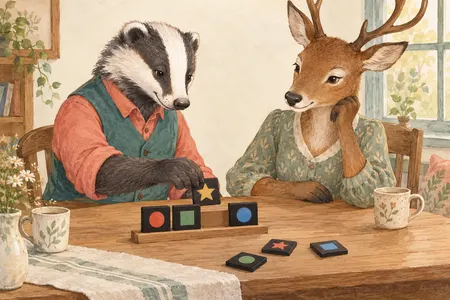
Original Qwirkle offers color-and-shape lines without word building or a card-slapping race. The tile layout needs usable table space and a format that works for both players.
Skip it if: Table space or visual format is a poor fit, or you want a fast-reaction activity.
Check before buying: Confirm original Qwirkle, 108 tiles and the included items. Check the box's ages 6+ guidance and whether the edition's visual format suits everyone. Do not assume the original set includes tile racks or a board.
Compare before you choose.
Open the question that matters to your choice. These are researched comparisons, not results from hands-on testing.
Compare the options side by side
Which one fits?
For two players, consider original Sushi Go! for competing over card combinations, The Mind for a shared challenge with limited communication, or original Qwirkle for turn-based color-and-shape tile play. All three reviewed ranges include two, but their rhythm and demands are different.
| Their everyday clue | Start here | The exact choice |
|---|---|---|
| You want to compete over card combinations | Original Sushi Go! → | 2–5 · ages 8+ · competitive pick-and-pass |
| You want a shared challenge with no card talk | The Mind → | 2–4 · ages 8+ · cooperate without card talk |
| You want deliberate turns without spelling | Original Qwirkle → | 2–4 · ages 6+ · 108 wooden tiles · growing layout |
Before you buy
- Agree on rivalry, cooperation or considered turns.
- Read the exact edition's two-player rules and allow learning time.
- Check language, visual format, table space, duplicate ownership and total cost.
A screen-free evening does not need to be an ambitious event. Choose a kind of play you both welcome and leave enough time to learn it. A game that fits that small plan is a stronger gift than a box chosen for a general “couples” label.
A few questions before you choose
Have you ranked these through two-player testing?
No. These are research-based editorial directions using the reviewed editions and publisher information, not a hands-on ranking or a promise about enjoyment.
Does Qwirkle need spelling?
Its original format uses colors and shapes rather than word building. That does not remove the need to check the visual format and rules for both players.
Research notes and source limits
What remains unverified
Sources and the limits of this article
By WishNudge. Original scenario-based analysis using the product identities and editions reviewed on October 4, 2026. We have not tested these products. There are no live prices, stock claims, popularity rankings or promised outcomes. Check the selected listing before buying.
More gift context
You have an evening, another episode is an option, and a game sounds like a welcome change. A two-player gift is most convincing when it gives you a type of time together you both want: a rivalry, a shared attempt or a sequence of considered turns.
Do not start by guessing which game is “best for couples.” People differ, and two people can want different evenings on different days. Start with the mood and the exact edition's rules, then check that the game is actually new to the person receiving it.
Working together and playing against each other are different gifts.
A competitive game gives each person their own result to pursue. A cooperative one makes the shared attempt the point. Ask which sounds appealing today rather than assuming everyone enjoys rivalry or that cooperation is always the gentler choice.
The Mind's communication constraint is central to its appeal. If you mainly want to chat through the game, that is a reason to choose a different route. Shared silence can be an interesting activity, but it is not a guaranteed connection exercise or a test of your relationship.
Leave room for learning, not only the number printed on the box.
Gamewright lists a 15-minute playing time for original Sushi Go!; Pandasaurus also lists 15 minutes for The Mind. An explanation, a first attempt or another round changes the time you actually spend. Do not build a tightly timed evening around those estimates.
Qwirkle's tile layout also needs space to grow. A game for two still needs an appropriate surface and visual format. Check whether both players can comfortably distinguish the colors and shapes, rather than treating the absence of words as a universal accessibility claim.
Make the invitation specific without making the game compulsory.
A note saying “shall we try this after dinner?” gives the gift a moment to belong to. It also leaves the recipient room to say another night would be better. The game does not need to arrive with a schedule they have to follow.
If you are buying for someone else, confirm the English-language rules and the exact version. Original Sushi Go! is not Sushi Go Party!; original Qwirkle is not the Travel or Cubes version. The product name is only useful when it identifies the actual box you intend to buy.
Find an exact product name
The exact options, with a reason to choose or skip
Game nights · Exact-item reference
For two people who want a friendly rivalry
Gamewright Sushi Go! Original Card Game
Read this item’s reason to choose, when to pass, and buying checks above →
Product identity and edition checked October 4, 2026; not a hands-on test. Edition, source and buying checks are in this item’s card above.
See original Sushi Go! on Amazon (paid link)Game nights · Exact-item reference
For two people curious about a shared silent challenge
Pandasaurus Games The Mind
Read this item’s reason to choose, when to pass, and buying checks above →
Product identity and edition checked October 4, 2026; not a hands-on test. Edition, source and buying checks are in this item’s card above.
See The Mind on Amazon (paid link)Game nights · Exact-item reference
For two people who would rather think through a turn
MindWare Qwirkle, Original, 108 Wooden Tiles
Read this item’s reason to choose, when to pass, and buying checks above →
Product identity and edition checked October 4, 2026; not a hands-on test. Edition, source and buying checks are in this item’s card above.
See original Qwirkle on Amazon (paid link)Keep choosing